How should children interact with a cat?
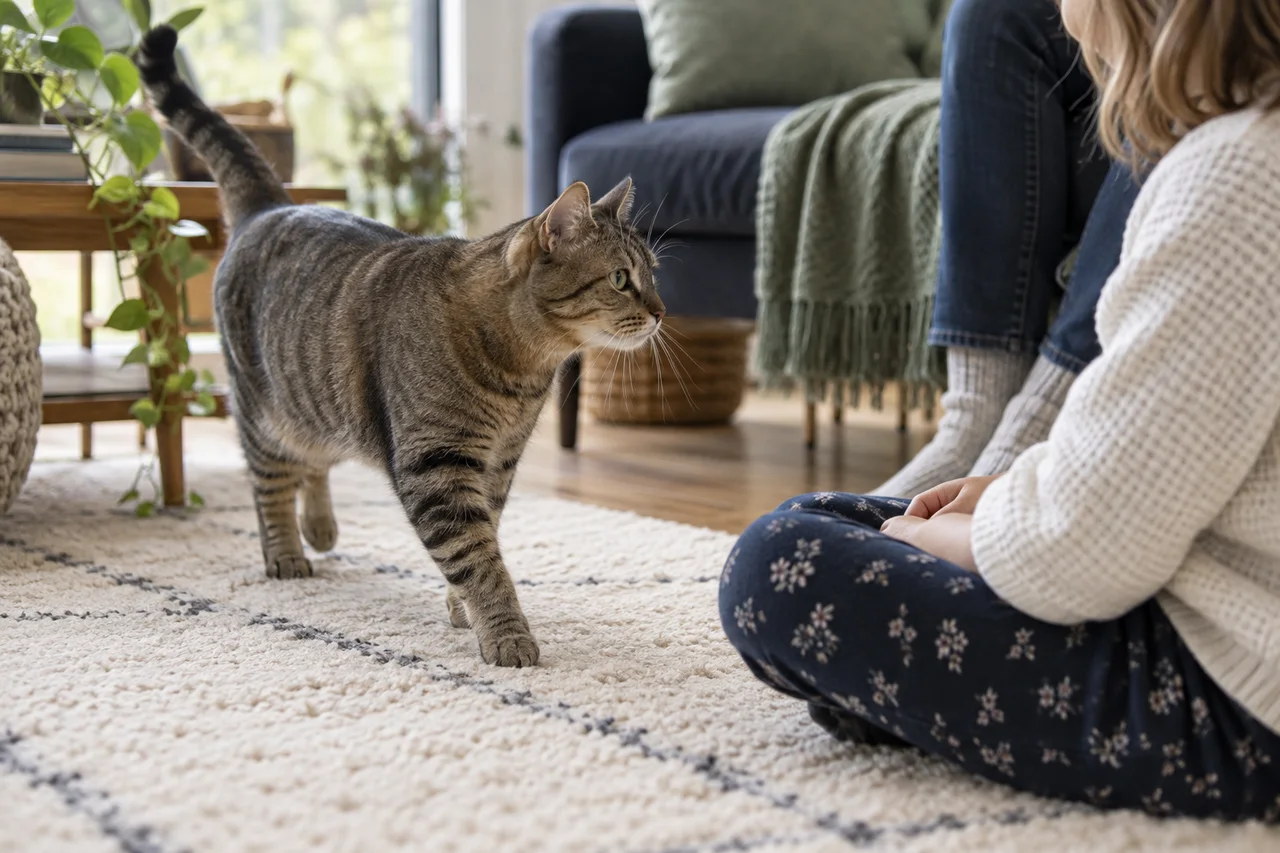
Supervise interactions, teach gentle handling, and let the cat approach and leave freely. Protect resting and feeding spaces from interruption. A retreat that children cannot access gives the cat a dependable break.
A child can learn to notice a cat walking away, turning their ears back, or moving their tail quickly. Make stopping a successful part of the interaction, not a disappointment. Explain that a sleeping cat needs uninterrupted rest.
An age-appropriate helper can check whether fresh water is available or choose a supervised toy with an adult. Keep feeding amounts and medication under adult control. Predictable responsibilities work better than unlimited access to the cat.
A child can learn kindness and practical care, but an adult remains responsible for the cat’s safety and daily needs. Match any task to the child’s ability, attention, and understanding, then supervise it. A promise to feed the cat is not a reason for an adult to stop checking that meals, water, and litter care actually happen.
Supervision means paying attention to the interaction and being able to intervene promptly. Being somewhere in the same home while occupied with another task may not provide that. With a baby or young child, arrange secure separation whenever active supervision is not possible. Protect both the child and the cat from situations they cannot manage themselves.
Discuss expectations before bringing a cat into a household with children. Some cats cope better with quiet homes, while others have positive experience with family activity. Ask the adoption organization about the individual cat. Choosing a good match and preparing protected spaces is more useful than expecting affection to solve every difficulty.
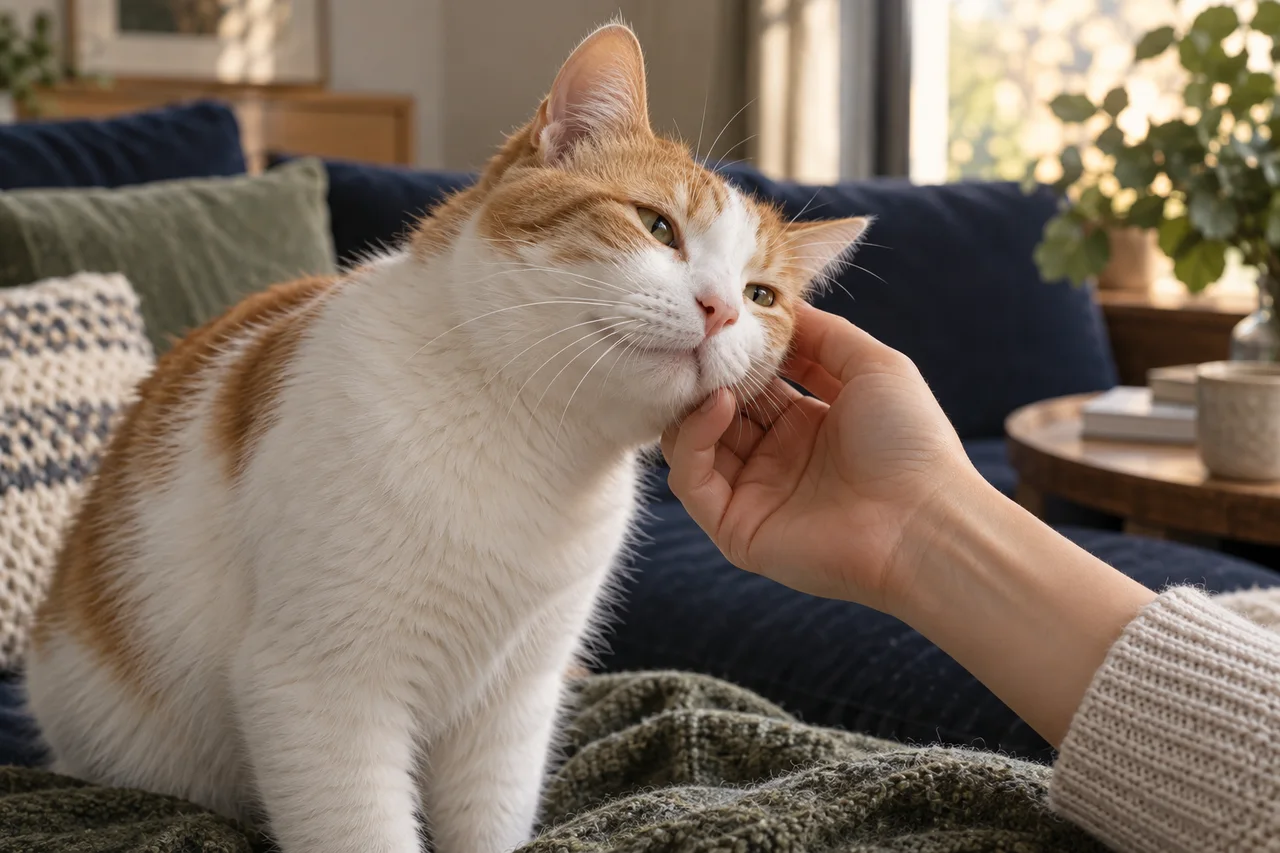
Begin with the child sitting calmly and letting the cat decide whether to approach. Explain that watching a cat from a distance is also a successful interaction. If the cat approaches comfortably, an adult can demonstrate a gentle stroke in an area the cat accepts, followed by a pause.
The pause matters. It gives the cat an opportunity to remain, move closer, or leave. Teach the child to keep hands still when the cat moves away and to let the interaction end without following. Avoid grabbing paws or tails, hugging tightly, placing faces close together, or picking the cat up simply because the child is excited.
Use concrete language a child can remember: “Let her come to you,” “One gentle stroke, then wait,” and “Her bed is her quiet place.” Praise the action of stopping when the cat has had enough. That helps the child understand respect as something they can do well, rather than as a disappointing limit imposed by an adult.
 View image
Teach a brief gentle touch followed by a pause, with the cat free to leave.
Children do not need to identify every subtle feline signal before they can behave thoughtfully. Start with clear events: the cat walks away, ducks from a hand, becomes tense, turns the ears back, or moves the tail sharply. The shared response can be simple: stop touching, give space, and let an adult assess the situation.
Avoid teaching that a purr or an exposed belly always invites stroking. Signals make sense in context, and a cat may want company without wanting a particular kind of contact. Explain this through the child’s own experience: sometimes a person wants to sit nearby without being hugged.
Watch together during calm moments. You can say, “She moved to the chair, so we will let her rest,” rather than asking the child to predict a bite. Adults should act before the cat has to escalate to growling, swatting, or biting. The goal is to notice and respect smaller requests for space, not to test how much handling the cat will tolerate.
An appropriate toy lets a child enjoy a cat’s interest without offering fingers or feet as targets. An adult should choose and supervise the game, keeping the toy away from the child’s face and body. Make sure the child can control the equipment safely; a smaller child may be better involved by choosing a toy while an adult moves it.
Demonstrate slow movement, pauses, and chances for the cat to catch the toy. Avoid games that require cornering the cat, chasing them through rooms, or waking them to participate. Stop if excitement makes the child run, shout, or wave the toy unpredictably. Put stringed toys away after the session.
Other shared activities can be quieter: reading nearby, helping an adult refresh water, or arranging a safe box for the cat to investigate later. A relationship does not have to revolve around touch. Giving children several acceptable ways to be involved reduces the pressure to hold or cuddle a cat who prefers more distance.
The cat needs resting places children cannot invade and routes that do not end in a corner. Keep feeding and toileting areas protected from interruption. A child should not wait at a litter-box entrance or reach into a hiding place to continue a game. Explain that these areas serve the cat even when the family cannot see what is happening inside.
Use secure room arrangements where necessary, with essential resources available to the cat. Check that any barrier is appropriate for the household rather than assuming a standard gate will contain every child or animal. An elevated place may offer choice, but it is useful only if the cat can reach and leave it comfortably.
Revisit the arrangement as a baby starts crawling or a child learns to open doors. New abilities change which spaces remain private. Keep pet supplies, medicines, and waste beyond a child’s reach, and maintain normal handwashing after handling litter-related equipment. Adults should control medication and feeding amounts even when children help with simpler tasks.
 View image
Make a retreat private so taking a break does not become another interaction.
If the cat hisses, swats, or bites, calmly separate the interaction and attend to any injury. Do not punish the cat or ask the child to immediately try again to prove there is nothing to fear. Give both a chance to settle, then work out what happened before the incident.
Useful questions include whether the cat was sleeping, eating, being held, or unable to leave. Did the child miss a request for space, or did the behavior change suddenly during familiar contact? A cat who becomes newly intolerant of touch should be assessed by a veterinarian because discomfort can affect behavior.
Seek appropriate medical advice for bites or concerning scratches, and professional behavior support if fear or conflict repeats. Adjust the environment and supervision while help is arranged. A healthy relationship can include considerable distance at first. Progress means the child and cat can share daily life safely and comfortably, not that the cat eventually accepts every form of affection.
Respecting a cat’s choice is a skill children can learn.
Keep exploring the evidence.
AI-assisted educational content, with links to veterinary and animal-welfare resources. Not independently reviewed by a veterinarian. Sources are references, not endorsements of Coricat. Images are AI-generated illustrations, not clinical evidence.
Our editorial standards