How can I understand my cat’s body language?
Look at the whole cat and the situation. A loose body and soft gaze often suggest comfort; flattened ears, tension, or a rapidly moving tail mean it is time to pause and give space. No single signal tells the whole story. Notice what changes when you approach, touch, or alter the surroundings.
A body-language chart can help you notice ears and tails, but a living cat does not hold one neat pose at a time. A cat may investigate a visitor, become uncertain when a hand reaches forward, and relax once the visitor turns away. The movement between those moments is often more informative than any still image.
Start with three questions: what happened just before, what is the cat doing now, and what changes when the pressure reduces? You do not have to name an emotion perfectly to respond kindly. If the cat stiffens when you move closer, stop approaching. If they choose to return once you sit quietly, you have useful information about the distance they find comfortable.
A relaxed-looking face on a tightly crouched body should make you look again. Notice whether the muscles appear loose, whether weight is distributed comfortably, and whether the cat is leaning into an interaction or preparing to move away. A cat pressed against a wall has different options from one resting in the middle of an open room.
Stillness is not always relaxation. Ask whether the cat chose to remain or has become motionless while being held, cornered, or watched by another animal. Give space and an exit before interpreting the response. In everyday life, this means leaving room beside a chair, not blocking a carrier doorway with your face, and allowing a cat on your lap to get down.
Ears move to follow sounds as well as during social interactions. One ear turning toward a noise behind the cat is not, by itself, evidence of anger. Compare ear position with the eyes, posture, tail, and activity. An abrupt change during handling matters more than a position seen without context.
If ears rotate back while the body stiffens and the cat stops leaning toward your hand, pause contact. If a relaxed cat turns one ear toward a kettle and then resumes resting, there may be nothing to do. Avoid getting close to inspect ears when the cat is already worried. Your response should make the situation easier, not add another unfamiliar movement for the cat to process.
 View image
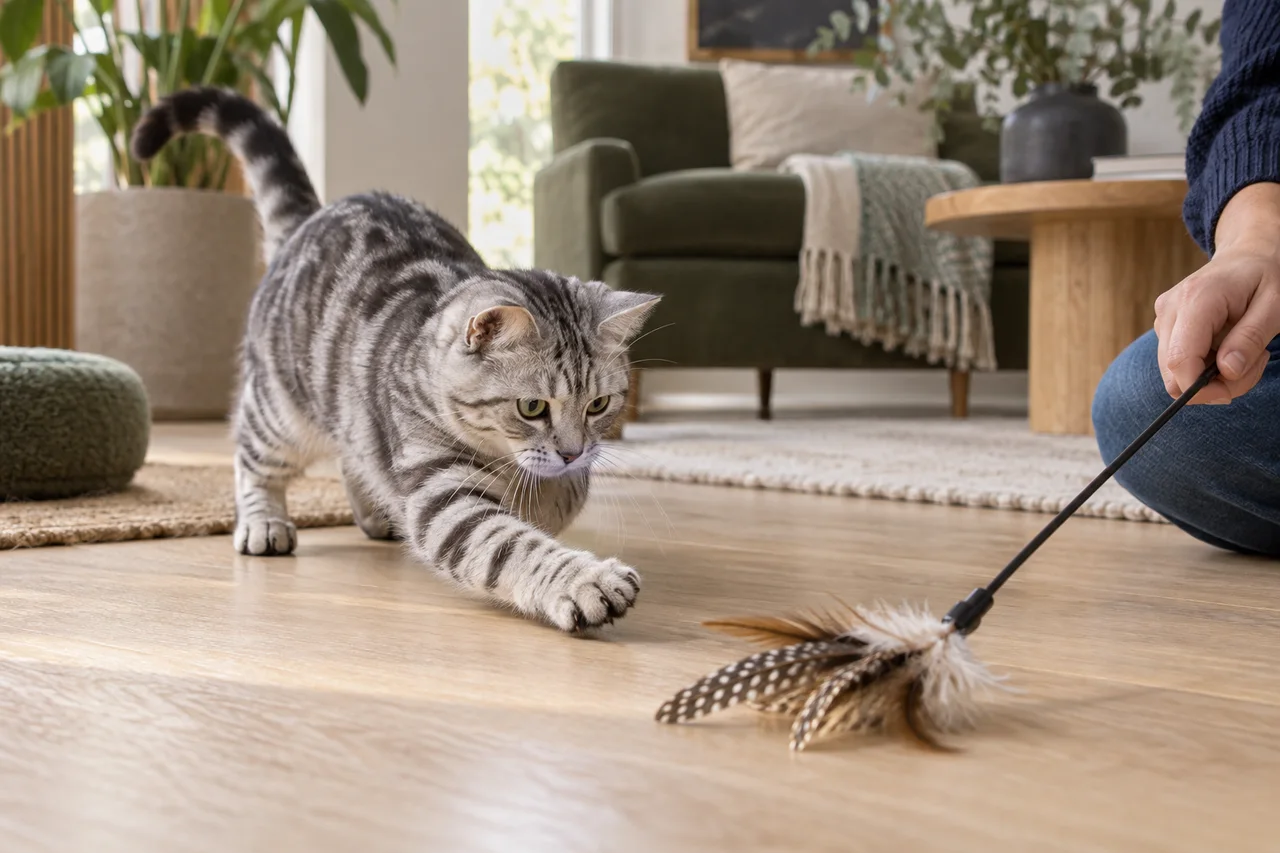
Read posture alongside the activity. A crouch during a toy game needs its surrounding context.
An upright tail during an approach can accompany a friendly greeting. A tucked tail together with a low posture can accompany fear. Rapid movement during an interaction can be a useful cue to pause. Yet the same tail also helps the cat balance, and movement while watching a toy may belong to an absorbing game.
Compare a greeting at the door with a wand session. In the greeting, the cat may approach loosely and rub against furniture. In the game, the body may become still while the tail tip moves and attention fixes on the toy. Rather than translating both movements into a single mood, ask what the cat is trying to do and whether you are helping or interrupting.
Pupils respond to light, so a wide pupil is not a reliable emotion detector by itself. A dim room, an exciting game, and a frightening event can produce superficially similar eye appearances. Notice the lighting and the rest of the body before drawing conclusions. Avoid shining a light into the eyes to test a response.
A soft gaze and relaxed eyelids may accompany comfortable resting. A fixed stare combined with tension deserves more distance. You can soften your own attention by looking slightly away instead of staring closely into the cat’s face. If the eyes look painful, one pupil appears different from the other, or there is a new eye problem, seek veterinary advice rather than interpreting it as a social signal.
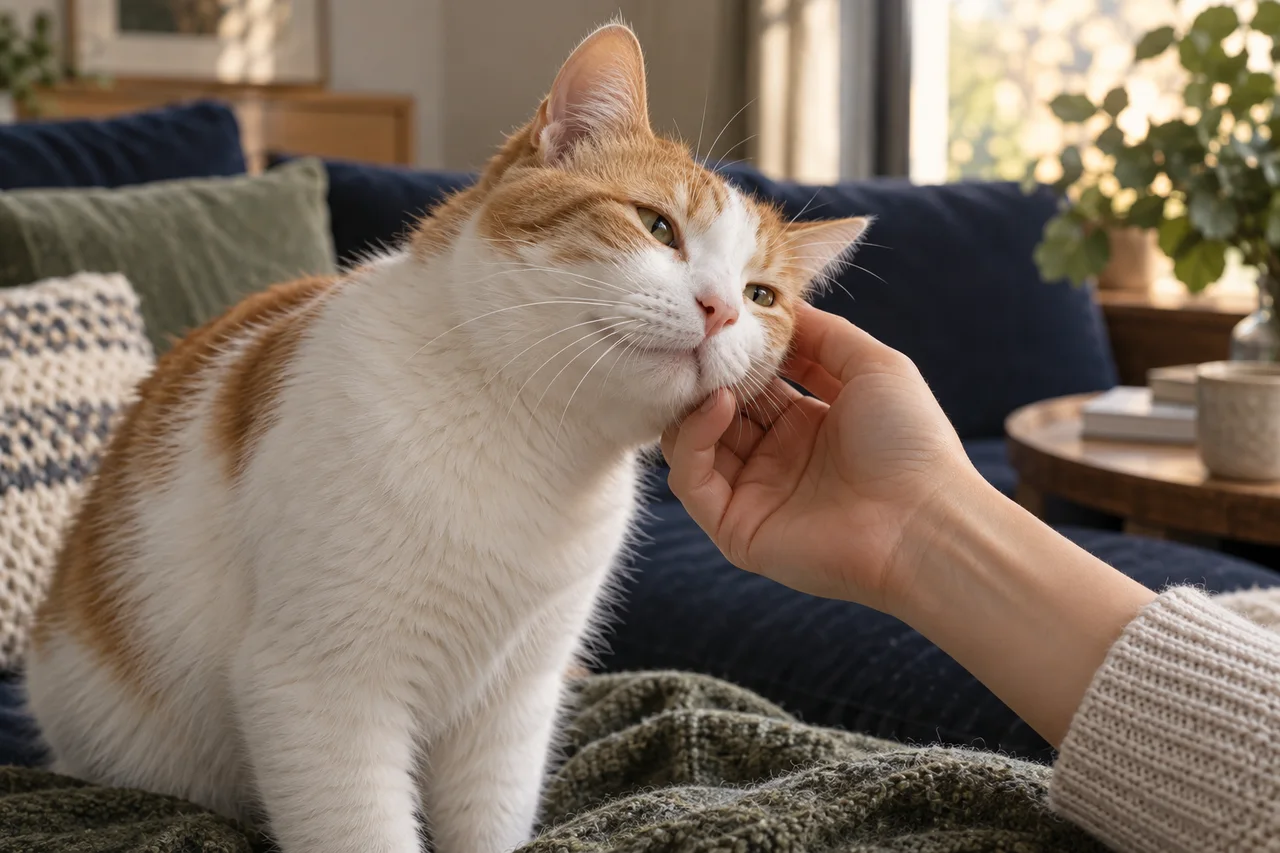
A cat can rub against your leg and then decline a stroke. They may roll onto their back while resting but object to a hand on the belly. Purring does not guarantee that every part of an interaction is comfortable. Treat each invitation as specific and temporary, rather than permission for anything that follows.
The practical habit is simple: offer a small response, then pause. A cheek rub need not become lifting, a lap visit need not become restraint, and a playful approach need not become rough handling. This makes your own behavior easier to predict. It also prevents the common frustration of feeling rejected after a cat seemed friendly, when the cat may simply have wanted a different kind of interaction.
 View image
Pause after a brief touch and let the cat decide whether to approach again.
During play, a cat may crouch, watch intensely, and move in short bursts. During fear, they may also crouch and watch. The object of attention, the ability to disengage, and what happens next help distinguish the situations. Does the cat voluntarily return to the toy, or retreat farther when someone moves?
When unsure, lower the intensity. Stop moving the toy, step back, or let the cat leave. A game can restart if the cat chooses. There is no benefit in proving that a worried-looking cat was actually enjoying themselves by continuing until the answer becomes obvious. With two cats, watch both participants and make sure apparent play is not consistently one animal pursuing another who is trying to escape.
Choose three familiar scenes: your cat waking from a nap, approaching a meal, and greeting someone they know. Notice posture before you intervene. Then watch a small change, such as your hand reaching for a bowl or a person standing up. This gives you a personal reference for the cat’s normal movements.
If another caregiver sees something different, compare the circumstances rather than deciding who understands the cat best. One person may encounter relaxed mornings while another sees busy evenings. Children can join by describing what they see in plain words: “tail moving,” “ears turned,” “walked away.” Observation comes before interpretation, and simple descriptions are easier for the whole household to act on consistently.
Body language can tell you that something is different without telling you why. New withdrawal, a hunched resting posture, sensitivity to touch, or a reluctance to jump may need medical investigation. A cat who has become less interactive should not automatically be described as grumpy or old.
Bring your veterinarian a concise account of what changed and when, including eating, drinking, litter use, grooming, and movement. A naturally captured video may help if the behavior is hard to describe. Meanwhile, provide comfortable access to essential resources and reduce unnecessary handling. The skill you are building is not mind-reading; it is noticing the cat early enough to offer space, adjust an interaction, or obtain appropriate help.
Read the whole cat, the surroundings, and the change over time. When signals are mixed, pause and give the cat room to choose the next step.
Keep exploring the evidence.
AI-assisted educational content, with links to veterinary and animal-welfare resources. Not independently reviewed by a veterinarian. Sources are references, not endorsements of Coricat. Images are AI-generated illustrations, not clinical evidence.
Our editorial standards