
How do you feed two cats without food stealing?
Working out how to feed two cats starts with separate feeding locations, which make it easier for them to eat without competition and help you notice individual appetite changes. Even cats who sleep together may prefer privacy at mealtimes. Each cat should be able to approach, eat, and leave without another animal taking the food or controlling the route.
An empty pair of bowls does not prove that both cats ate enough. One may finish quickly and move to the other’s food; another may wait outside the room until the first has gone. Watch who approaches, who pauses, and who leaves, as well as what happens while they are eating.
Quiet tension can be easy to miss. A cat may repeatedly look up, change position when another enters, or abandon a meal without any hissing. These observations are reasons to improve the arrangement, not to assign permanent labels such as greedy or timid. The feeding system should make appropriate access easy for each cat, rather than requiring one animal to defend a bowl successfully.
Bowls placed in a row still require cats to eat close together. Add distance and visual separation where practical, or use different rooms for meals. Think about the route into and out of each location. A secluded corner can still be awkward if the only exit passes directly beside another cat’s bowl.
Sketch the available space and choose a named place for each cat. A kitchen station and a quiet adjacent room may work better than opposite ends of one busy doorway. Make sure the second location is comfortable and familiar, with safe footing and enough room to turn. Avoid placing a less confident cat’s food somewhere they rarely choose to go simply because it is out of sight.
Keep the food and other familiar details consistent while changing the location. Guide each cat toward their own place without carrying them into a tense encounter. If using separate rooms, make sure each cat is comfortable there and return normal access when the supervised meal is finished.
Expect a little practical adjustment. One cat may habitually walk to the old station, and caregivers may need a clear routine to prevent bowls being swapped. Labels or different mats can help people keep track. Do not rely on the cat understanding that a new decorative bowl means ownership. The arrangement works because access is managed and comfortable, not because the cats accept a household rule about whose bowl is whose.
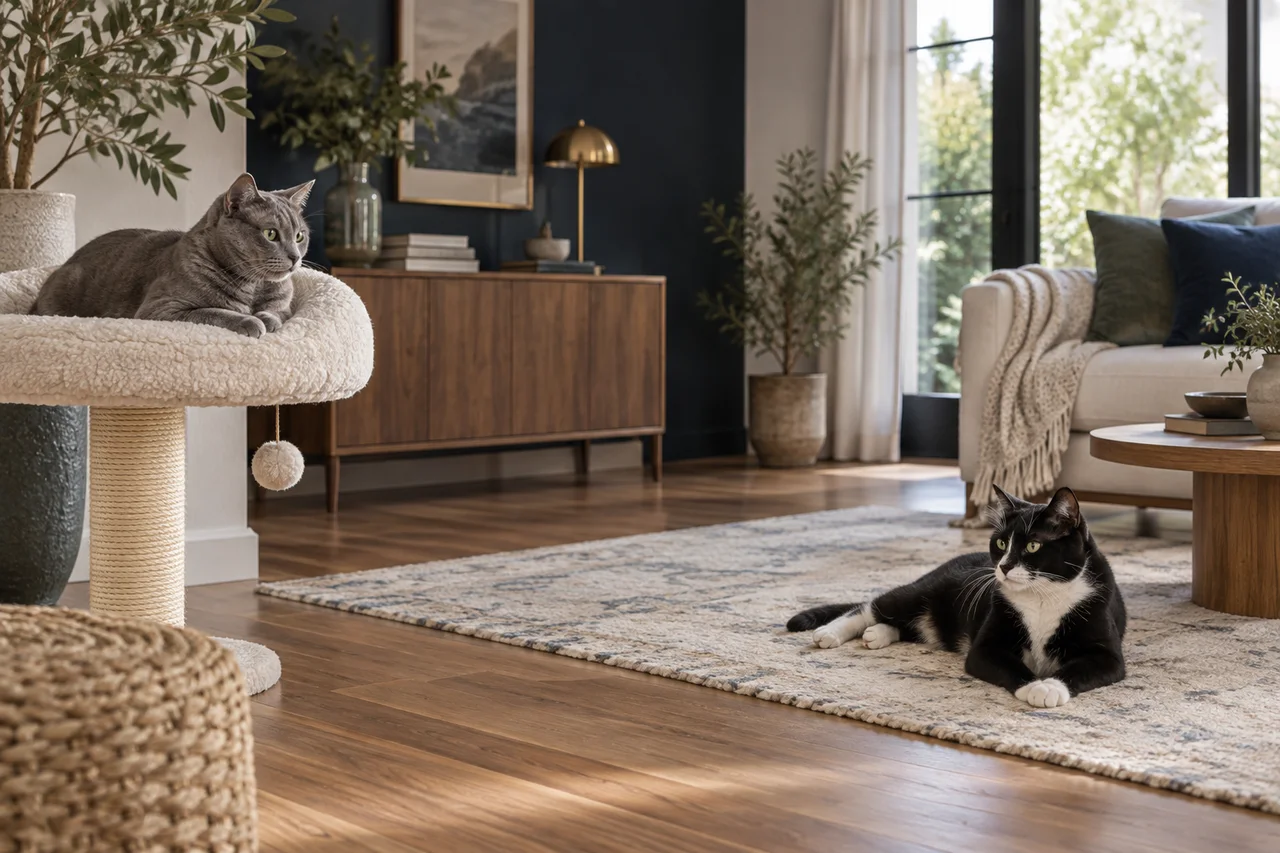
Leave space to approach and withdraw; relaxed access matters beyond the number of bowls.
Serve identified portions and check individual leftovers before other animals gain access. Keep the record as simple as needed: normal meal, part left, or refused. For a medical feeding plan, your veterinary team may want more precise quantities. Follow their guidance rather than guessing from a glance across the room.
This matters when one cat is gradually eating less. If a companion clears the leftovers, the shared total may look unchanged. Separate meals make the change visible sooner. Report a new reduction in intake even if competition seemed to be part of the problem. A calmer station is helpful, but it does not rule out illness or discomfort.
A growing kitten, an adult cat, and an older cat may need different feeding plans. A prescribed therapeutic food adds another reason to control access. Do not assume one product is suitable for everyone because all the cats enjoy it or because managing several foods is inconvenient.
Ask the veterinary team to translate each plan into exact products, daily quantities, timing, and permitted extras. Then work out the household logistics: where each meal is prepared, how bowls are identified, and when leftovers are removed. If a cat grazes slowly, explain that rather than forcing a schedule they cannot manage comfortably. The plan needs to meet nutritional needs and allow the individual cat to eat reliably.
A feeder that responds to a cat’s microchip or compatible tag can help some households control access, but it is not automatically the best first step. Consider whether the cat will approach the device, whether another animal can crowd the entrance, and how the unit will be cleaned and monitored.
Introduce it according to the manufacturer’s training instructions, keeping access to adequate food throughout. Test recognition and operation while you are present. Make sure the cat is comfortable with lid movement and sounds before depending on it. Have a fallback for battery failure or a sitter who cannot troubleshoot the device. Equipment is useful when it supports a clear feeding plan; it should not make eating conditional on mastering an unfamiliar mechanism.
Dogs, children, and visitors can affect feeding even when the cats themselves get along. Keep dogs from approaching cat bowls and ask people to leave eating cats in peace. A meal should not become the moment someone tries to lift the cat or practice handling without a separate, appropriate plan.
Agree who serves which meal and how completion is marked. In a busy home, a simple message or kitchen marker can prevent duplicate feeding. If a sitter is taking over, demonstrate the actual routine rather than leaving only a list of food amounts. Show where each cat waits, how doors are managed, and what a normal meal looks like so a change is easier to notice.
Separate meals do not solve every resource problem if all water remains in one contested corner. Provide fresh water in several accessible places and watch whether each cat can use it comfortably. Consider the rest of the daily route, including litter and resting areas, when deciding where feeding stations belong.
Food puzzles should also be offered in a way that avoids competition. A slower cat may need a private session with an easy puzzle while the other is occupied elsewhere. Use each cat’s planned food allowance and check what is actually eaten. Enrichment should add an enjoyable opportunity, not create another valuable object that one cat can monopolize.
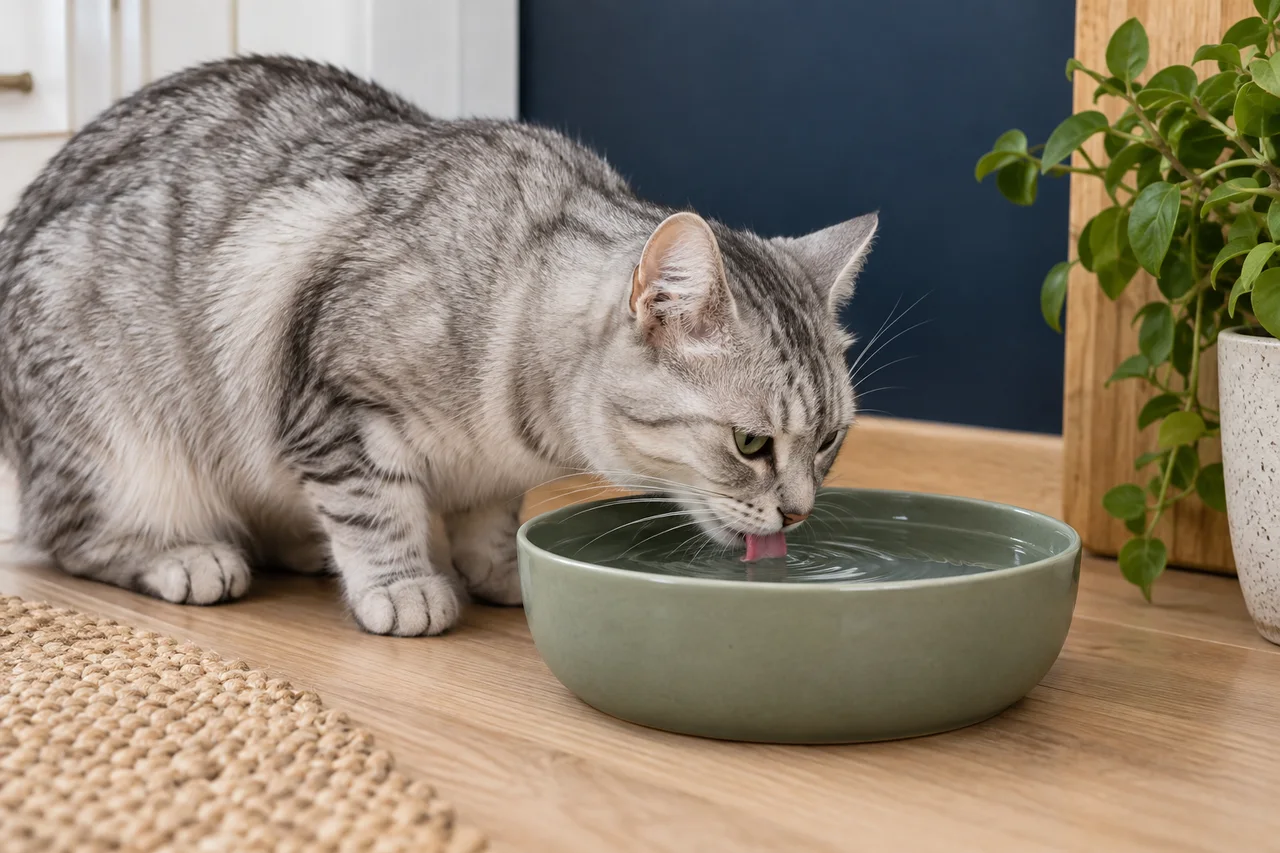
Extend separate, comfortable access to water as well as meals.
After the new arrangement has been used for several ordinary meals, ask whether each cat approaches readily, eats comfortably, and leaves freely. Success is not just the disappearance of visible stealing. A cat who still waits upstairs until the household is quiet may need a different route or a feeding place closer to their comfortable area.
Make one practical adjustment and watch the result. If tension persists or the cats cannot share the home comfortably outside meals, ask your veterinarian for help and qualified behavior support. Feeding is one part of the relationship between cats. A good meal arrangement can reduce pressure, but it should sit within a home that offers each animal safe access to daily necessities.
How do I stop one cat eating the other’s food?
Feed them in separate rooms or at opposite ends of a hallway, on a schedule you can supervise, and pick the bowls up after the meal. If one cat still raids, a microchip feeder that opens only for the right cat can keep portions honest. Introduce the new arrangement calmly.
Should cats share a food bowl?
Sharing looks friendly, but it hides who ate what and lets a confident cat take more than their share. Separate bowls, a short distance apart or in different spots, make appetite changes visible. That information matters for weight and health.
Is free feeding okay with multiple cats?
Leaving food down all day makes it hard to know who ate what, and a food-motivated cat will usually find the other’s bowl. Measured meals give you control over portions and early notice of change. If your schedule makes meals hard, an automatic or selective feeder can help.
Do I need a microchip feeder for multiple cats?
It helps when cats are on different diets, such as a prescription food, or when one cat reliably steals food despite separate stations. The feeder opens only for the cat wearing the matching chip or tag. Many households manage well with supervised, spaced meals alone.
Give each cat a comfortable place, a clear feeding plan, and a way to eat without competition. Individual meals also make individual appetite changes easier to notice.
Keep exploring the evidence.
Original sources are linked directly so you can check their author, publication context, and updates.
- Cat Friendly Homes — What your cat needs to feel secure Original source
- FelineVMA — How to feed a cat Original source
- Cornell Feline Health Center — How often should you feed your cat? Original source
Educational content with links to veterinary and animal-welfare resources. Not independently reviewed by a veterinarian. Sources are references, not endorsements of Coricat.
Our editorial standards

