How can I make windows and balconies safer for my cat?
Use secure, cat-appropriate barriers and inspect them regularly. Ordinary insect screens and a cat’s sense of balance are not reliable fall protection. An enclosed outdoor space must prevent escape and provide shelter, shade, and a route back inside.
Start with windows, balcony doors, rails, and gaps behind furniture. Tilt-open windows can create trapping hazards. A cat watching birds may push through or lean on a barrier that seemed adequate while they were resting.
Treat the enclosure as a piece of safety equipment.
- Check fixings, gaps, mesh condition, and door latches.
- Confirm materials and installation are appropriate for cats.
- Provide shade, water, and a comfortable retreat.
- Recheck after storms, repairs, or changes to furniture.
Let your cat observe the new area before encouraging exploration. Record where they choose to rest and whether outdoor sounds cause alarm. A secure window perch may be a better fit than a larger space your cat finds overwhelming.
 View image
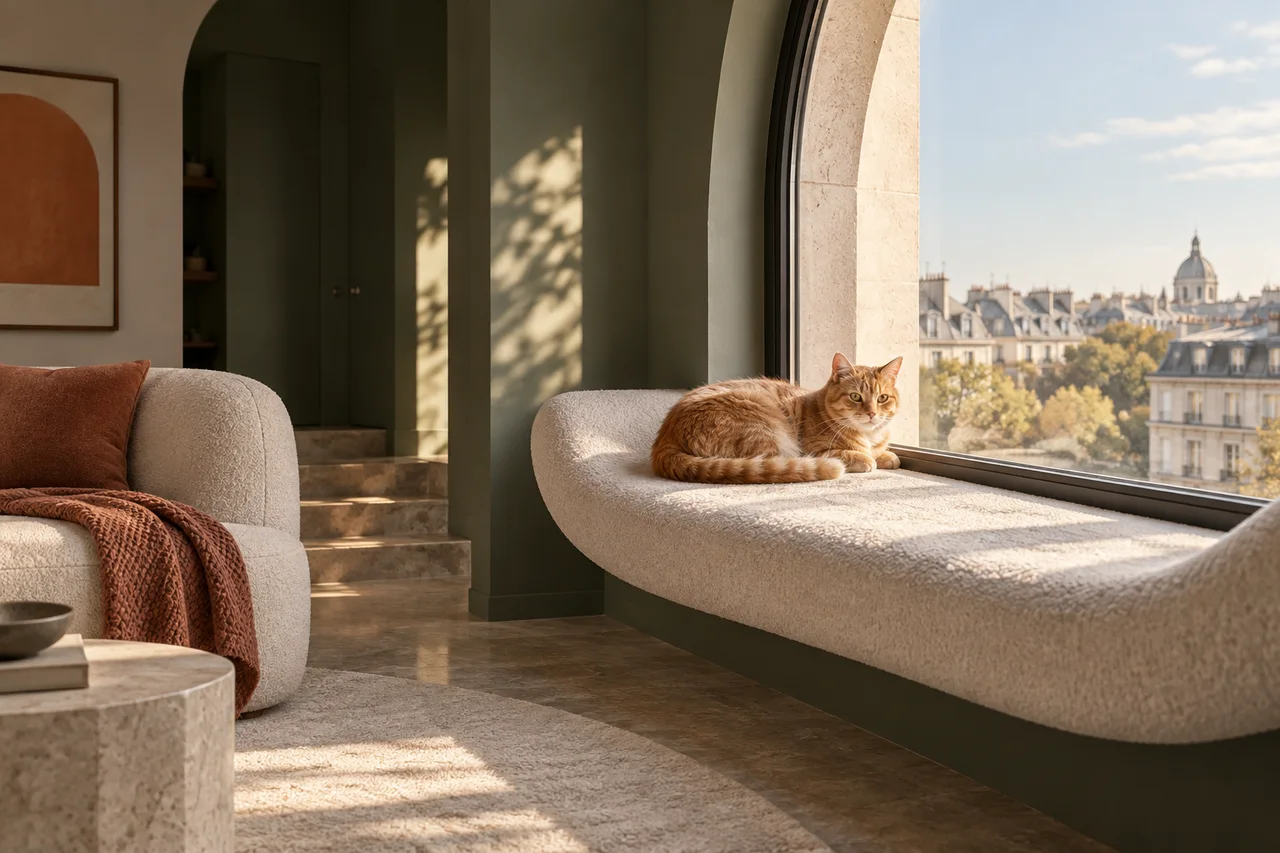
An accessible indoor view can offer interest while you assess suitable boundaries for outdoor access.
A barrier must withstand the cat’s likely actions, including leaning, climbing, pushing, and sudden movement toward an interesting sight. An insect screen is designed primarily to keep insects out, which does not establish that it can contain a cat. Likewise, a balcony railing may meet a building requirement without preventing a small animal from passing through or over it.
Use products and installation methods specifically suitable for the setting and for cats. Ask the installer or manufacturer how edges, corners, doors, and fixings are secured, and what maintenance is required. The complete installation matters; strong mesh attached to weak fittings does not make a dependable boundary.
Do not invent a universal safe gap size from an online photograph. Kittens, slender adults, determined climbers, and different window mechanisms create different challenges. If you cannot verify that an opening is safely protected, keep it closed while the cat has access. A temporary restriction is more useful than testing the gap with a curious animal.
A balcony assessment should include the route onto it, its sides, the overhead boundary, and anything that can become a climbing aid. Furniture, planters, stacked storage, and a drying rack may bring a cat close to an unprotected edge. Moving one chair can change the practical safety of an otherwise familiar space.
An enclosure needs to prevent escape without creating a trapping or entanglement hazard. Inspect corners and joins where materials meet, not just the center of each panel. Consider how a maintenance worker, delivery, or household member will enter and close the space. A secure structure can be undermined by a door left open during ordinary use.
Check permission and building requirements before installing permanent equipment, particularly in rented or shared properties. A suitable professional can assess structural attachment and weather exposure. Until the installation is complete and checked, keep the cat away from the area. Supervision is valuable, but it is not a reliable replacement for a physical boundary at height.
An enclosure can be secure yet unpleasant to use. Think about sun, rain, wind, the temperature of surfaces, and whether the cat can return indoors freely. Provide shade and a sheltered resting option, and avoid a layout that leaves the animal exposed when weather changes. Fresh water should be easy to reach whenever the space is in use.
Offer stable places to rest and observe without crowding the enclosure with equipment. The best arrangement depends on the individual cat’s mobility and confidence. A low resting platform can be more useful than a tall structure that is difficult to descend. Keep routes clear so another animal cannot trap the cat at the far end.
Outdoor sights and sounds are not automatically enjoyable. A neighboring dog, unfamiliar cats, machinery, or heavy foot traffic may be unsettling. Give your cat the choice to leave, and close access when conditions become unsuitable. A catio is an optional space for enrichment, not somewhere a cat should have to remain because the household is busy indoors.
 View image
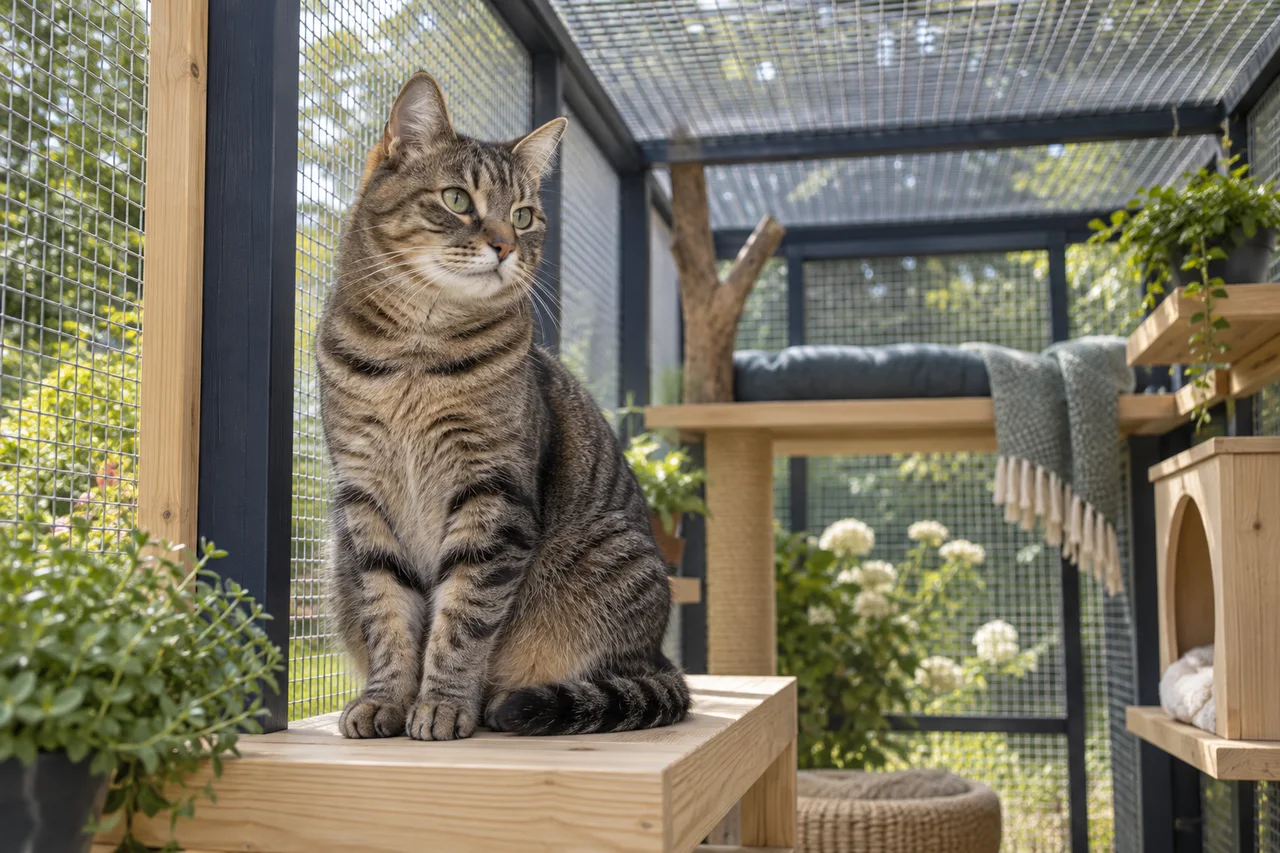
Include reachable fresh water and a comfortable retreat when planning time in an enclosure.
People need to ventilate their homes, so a workable plan must fit daily habits. List which windows are opened in the morning, during cooking, while cleaning, and overnight. Identify who operates them and whether the cat can enter those rooms. A rule that depends on remembering an exception at every opening is easy to break.
Tilt-open windows deserve particular attention because a cat can become trapped in the narrowing gap. Use appropriate protection or prevent access rather than assuming the opening is too small to matter. Check manufacturer guidance and the full mechanism, including what happens when a window is partly rather than fully open.
In a rental home where changes are restricted, discuss suitable options with the property manager and a competent installer. Meanwhile, separate the cat securely from a room being ventilated. Before reopening access, check that the window is closed or correctly protected. Make this a shared routine for housemates and visitors, especially when warm weather changes everybody’s usual habits.
A brief check can catch changes that a one-time installation inspection misses. Look at latches, panels, joins, and the immediate surroundings before opening access. Confirm that no maintenance work, moving furniture, or temporary cable has created a gap. If a door does not close as expected, treat that as a fault to resolve before the cat enters.
Do a more thorough inspection after storms, repairs, prolonged disuse, or visible wear. Follow the product’s maintenance instructions. Sun exposure, moisture, and repeated use can affect different materials differently, so a barrier should not be assumed sound simply because it was satisfactory last season.
Give a sitter a demonstration rather than only a note saying the balcony is safe. Show which door closes first, how the latch is checked, and when the cat must stay indoors. If a caregiver is unsure about the system, agree that access stays closed. A clear default prevents improvisation when you are unavailable.
Close access if your cat repeatedly paws at a weakness, climbs into a hazardous position, or seems frightened in the enclosure. Reassess the physical setup and the experience it offers. Repeated escape attempts are a practical reason to improve or stop using the arrangement; they should not become a challenge to see whether the barrier will hold.
After a fall or entrapment, contact a veterinarian promptly even if the cat appears able to walk. Visible movement does not establish that there is no injury. Follow professional advice about handling and transport, and avoid unnecessary movement while arranging care.
Do not put yourself at risk trying to reach an animal beyond a balcony or window. Keep others away from the hazardous area and contact appropriate local assistance. Once the immediate situation is managed, prevent further access until the cause has been corrected. A frightening near miss should lead to a concrete change in equipment or routine, not only a promise to watch more closely.
An interesting view should come with a dependable physical boundary.
Keep exploring the evidence.
AI-assisted educational content, with links to veterinary and animal-welfare resources. Not independently reviewed by a veterinarian. Sources are references, not endorsements of Coricat. Images are AI-generated illustrations, not clinical evidence.
Our editorial standards