How can I groom my cat without stressing them?
Choose a calm moment, let your cat inspect the tool, and begin with short strokes in an area they tolerate. Stop at signs of discomfort. Coat type, age, and health affect how much help a cat needs.
New mats, greasy patches, bald areas, or a marked change in grooming can have several causes. Notice when and where they appeared rather than assuming a cat is being lazy. Grooming is also a chance to spot a change in comfort with touch.
Begin below your cat’s tolerance, not at its limit.
- Place a suitable brush nearby and allow voluntary investigation.
- Try one or two gentle strokes, then pause.
- Reward calm participation in a way your cat enjoys.
- Make a note of sensitive areas to discuss with your vet.
Sketch the body and mark the location of a mat or skin change. Date a photograph taken in ordinary light if the cat remains comfortable. This gives a groomer or veterinarian a clearer starting point than repeated full-body handling.
Before buying several tools, look at coat length, the areas that tangle, and the places your cat accepts being touched. A short-haired cat and a long-haired cat may need different practical support, and two cats with similar coats may tolerate very different routines. Ask your veterinary team or a suitably experienced cat groomer which tool suits the coat and current skin condition.
Describe the problem you are trying to solve: loose hair on an otherwise comfortable coat, a recurring tangle behind a leg, or a new patch that looks greasy. These are different situations. Do not use force or progressively sharper equipment because one tool has not worked. When the skin is sore, the coat is tightly matted, or handling causes pain, professional assessment should come before an attempt to finish the grooming at home.
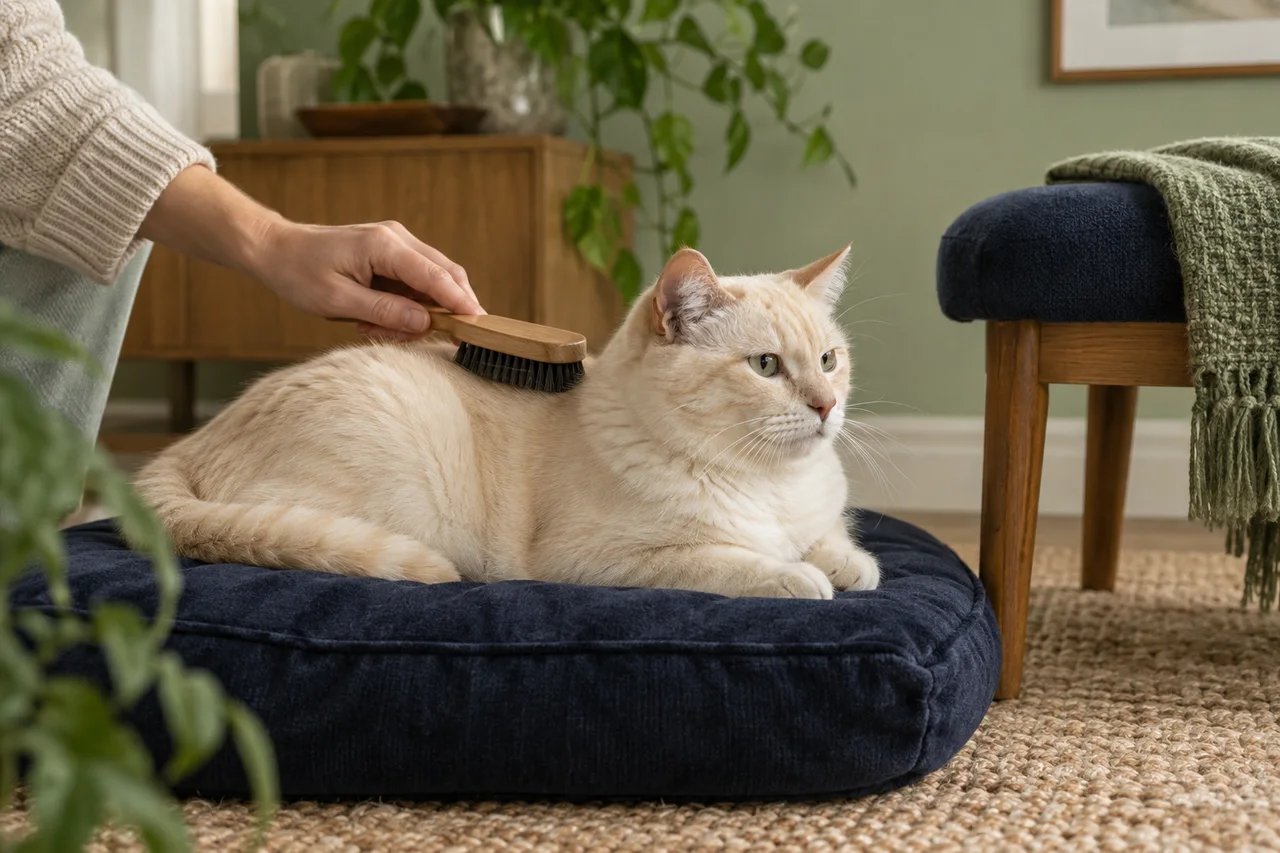
Choose a stable surface and a quiet moment. Your cat should not have to balance on a slippery counter while you reach across their body. Keep the tool within reach before inviting contact, and let the cat approach if possible. A familiar bed or floor-level resting spot may be easier than lifting the cat into a new position.
Start with an area your cat already accepts during ordinary touch. Try a very small amount, pause, and notice the whole response: posture, ear position, skin movement, tail, and whether the cat remains by choice. Turning the session into a pursuit around the room removes that choice. If the cat walks away, record where you stopped and put the equipment aside. A short successful encounter gives you something repeatable; completing every body area is not the objective of the first session.
 View image
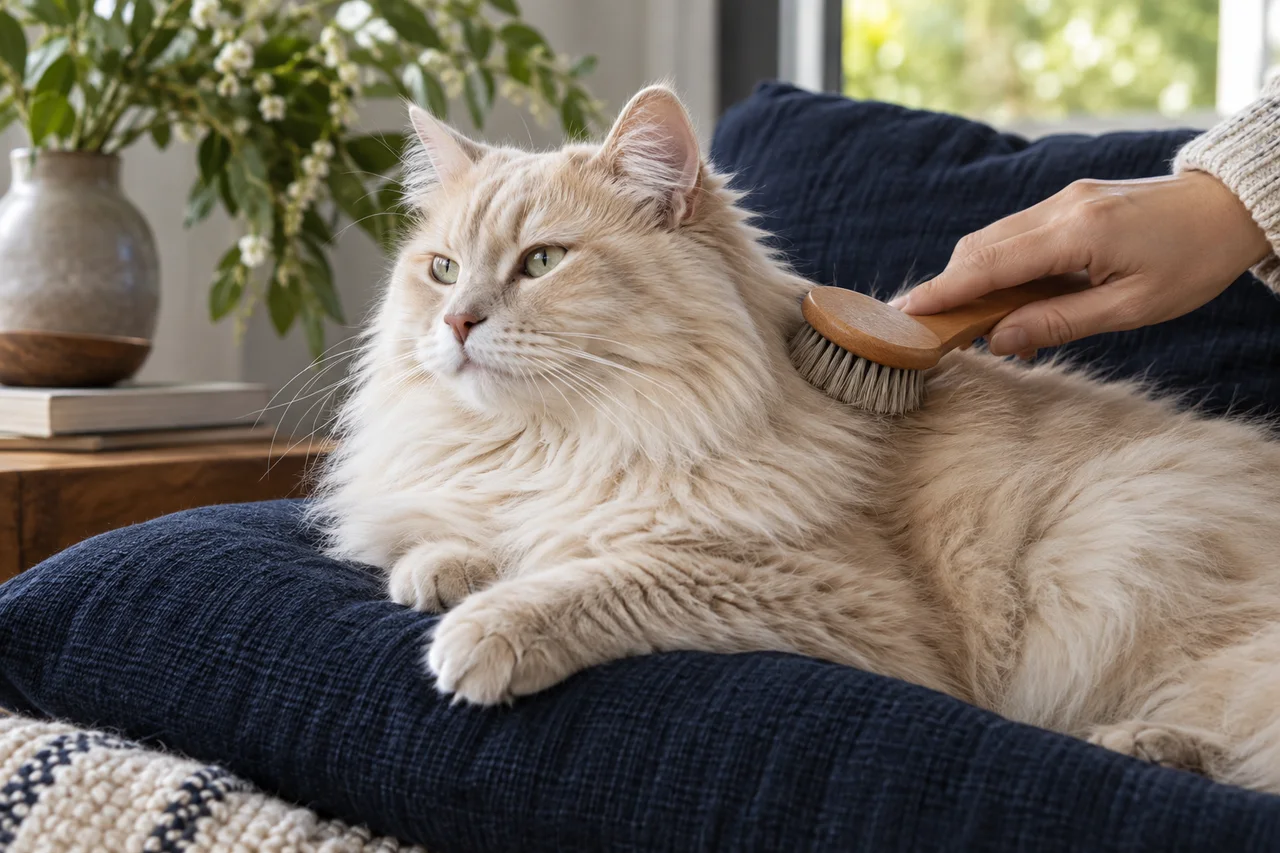
Offer a few accepted strokes while your cat rests in a position they find comfortable.
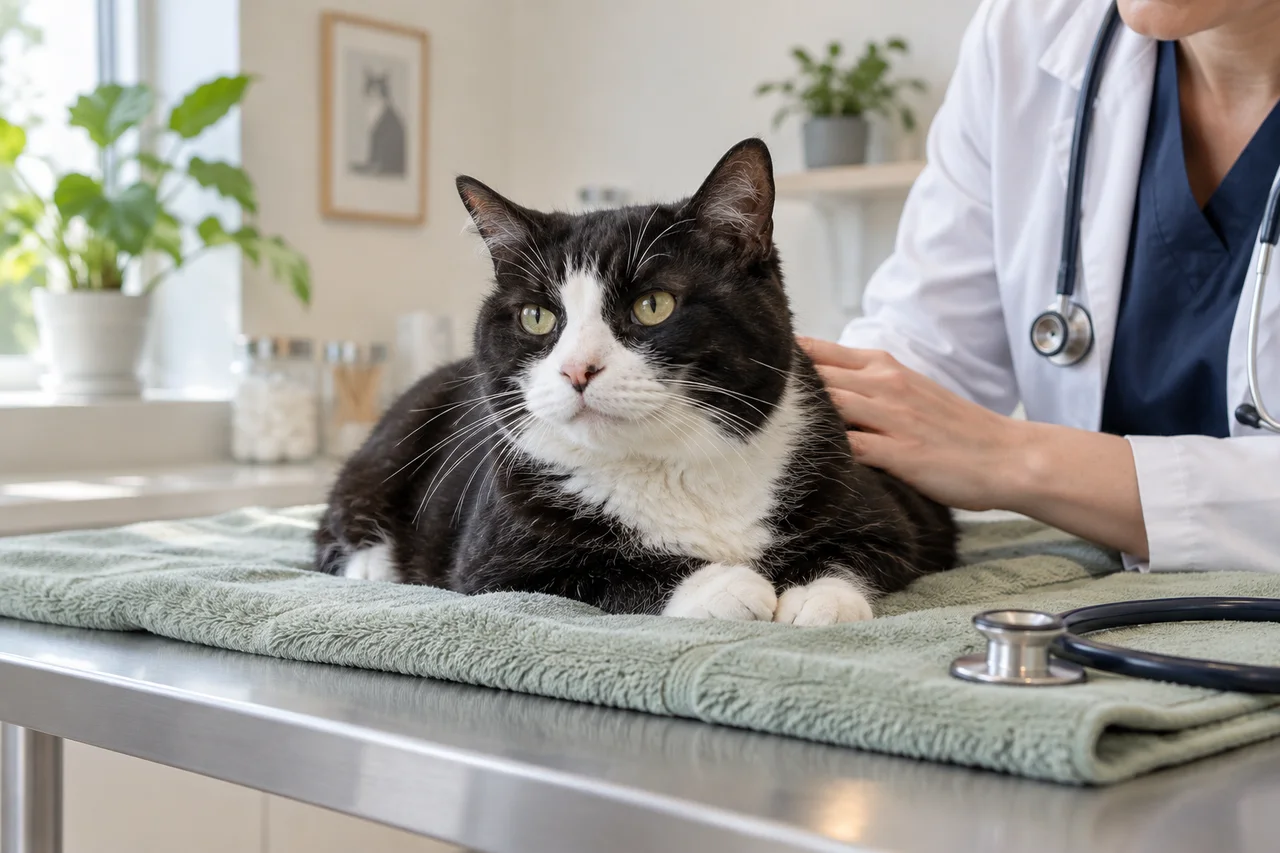
A cat who used to allow brushing over the back but now turns sharply may be telling you that something has changed. Do not assume it is stubbornness or that the coat simply needs a firmer stroke. Note the location, whether the response is new, and whether you have also seen changes in jumping, rest, or interaction. Tell the veterinary team before repeatedly testing the sensitive area.
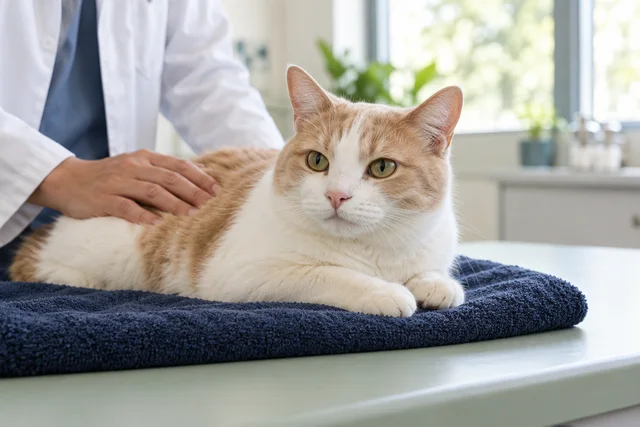
If a mat is present, leave its removal to an appropriate professional when it is tight, close to the skin, or painful. Cat skin can be caught within a mat and is difficult to judge from the outer hair. Do not slide scissors underneath to look for a supposedly safe gap. A photograph taken without disturbing the cat can show the location; it does not establish that home cutting will be safe.
 View image
Bring a new sensitive area or coat change to the veterinary conversation before repeatedly handling it.
A flaky patch, unexpected smell, or greasy coat is a reason to ask what is causing the change, not a reason to apply several remedies. Keep a record of any product already used, including shampoos, sprays, wipes, parasite treatments, and supplements. Photograph the full label so the veterinary team can identify it accurately.
Do not assume that a product described as natural, gentle, or suitable for people is appropriate for a cat. Ask before using a new topical product, particularly when the cat may groom it off. If something potentially hazardous gets onto the coat, contact a veterinarian promptly for specific instructions instead of starting an improvised bath. Bathing and ordinary brushing are different tasks, and a distressed cat should not be forced through either merely to complete a cosmetic goal. Explain the exposure or skin change first and follow the advice you receive.
A simple body sketch can show where tangles recur or where a coat change began. Add dates and a short description such as “new mat on left flank” or “less grooming over back.” If you take photographs, use similar lighting and distance so differences are easier to interpret. You do not need daily full-body inspection photographs or repeated turning of the cat.
In a shared household, name the person responsible for the routine and note what the cat comfortably accepted. This prevents several caregivers from each trying to finish the same difficult area. Ask a groomer or veterinary professional to explain how they want you to maintain the coat between appointments. Keep their instructions separate from your observations. If the recommended approach is not manageable at home, say so before the problem builds into another uncomfortable matting episode.
After several comfortable sessions, compare the cat’s willingness to participate and the practical condition of the coat. Does the cat remain relaxed? Are tangles becoming easier to prevent? Are you repeatedly stopping at the same body area? These questions are more useful than counting how much loose hair fills the brush. A change in the answer can prompt a discussion about technique, equipment, or health.
For an older cat or one with a known condition, ask whether position and duration need adapting. You may be able to groom an accepted area while the cat rests without asking them to stand or twist. Do not force a position to reach the last patch. Arrange professional help for work that cannot be done comfortably, and seek veterinary advice for new bald areas, wounds, marked coat changes, or a sudden loss of tolerance.
A short, comfortable session is easier to build on tomorrow.
Keep exploring the evidence.
AI-assisted educational content, with links to veterinary and animal-welfare resources. Not independently reviewed by a veterinarian. Sources are references, not endorsements of Coricat. Images are AI-generated illustrations, not clinical evidence.
Our editorial standards